MARK THOMAS GIBSON
The Voyage
January 17th-February 21st, 2026
Opening Reception:
Saturday, January 17th, 6-8 PM
KDR | 790 NW 22ND ST
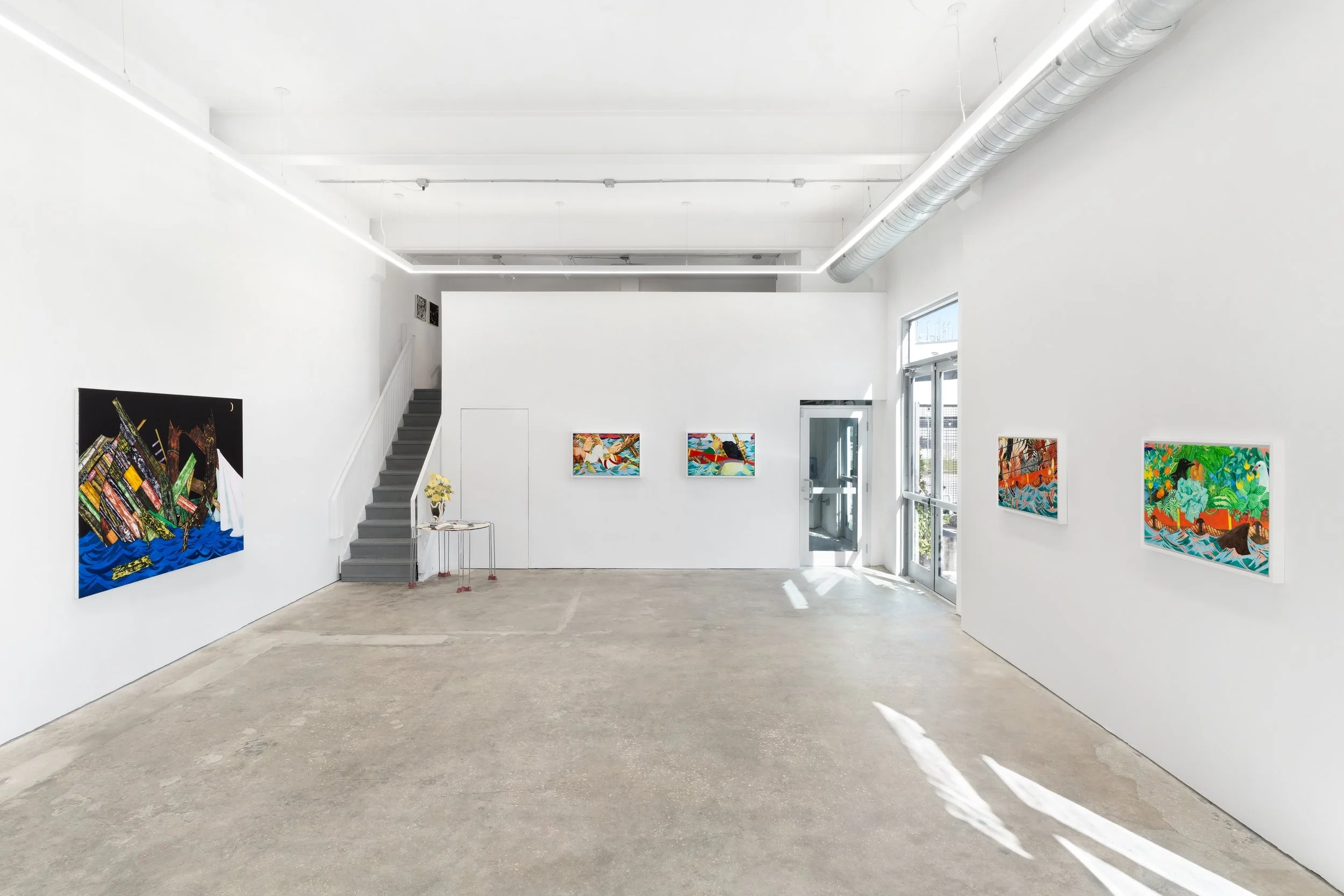
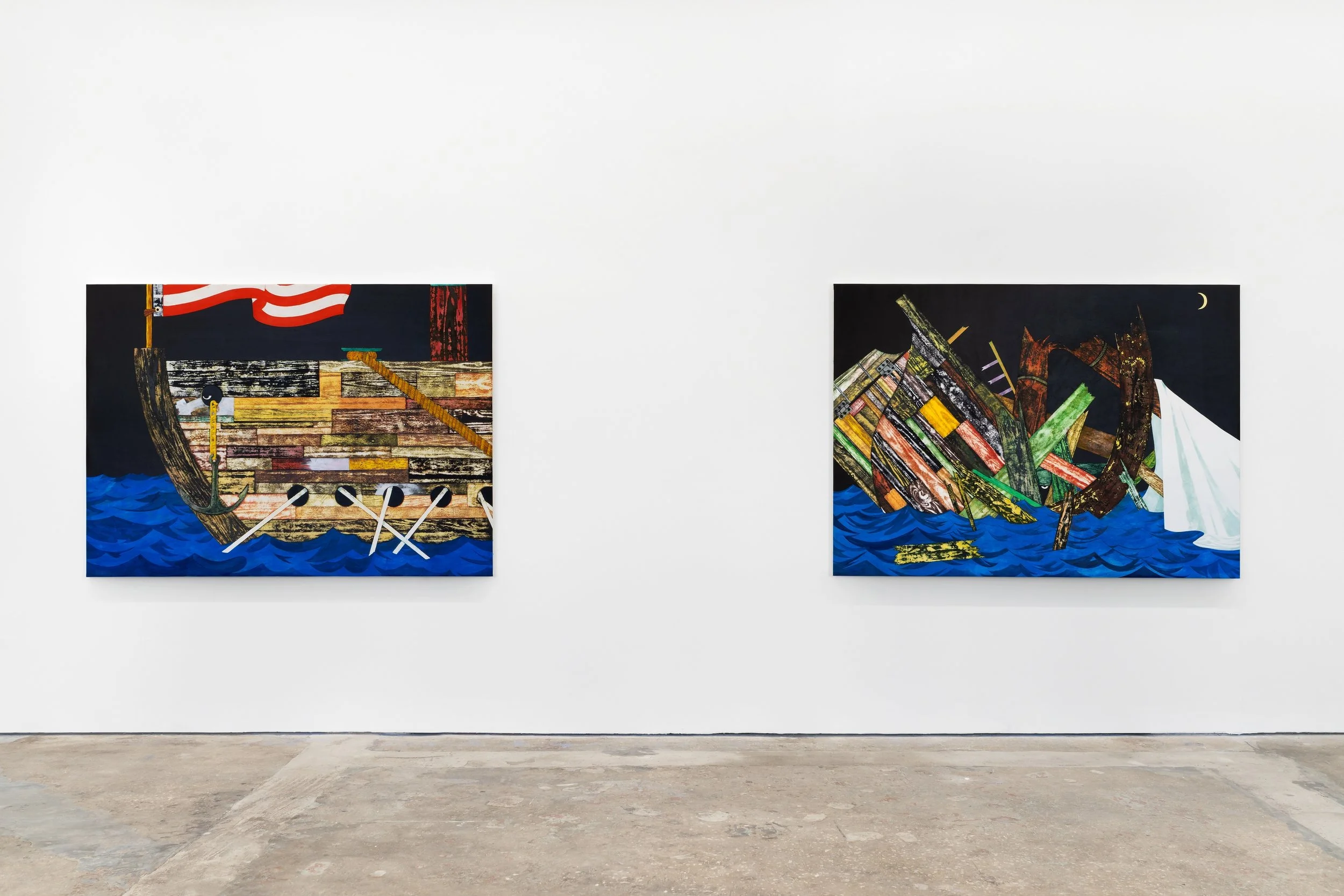
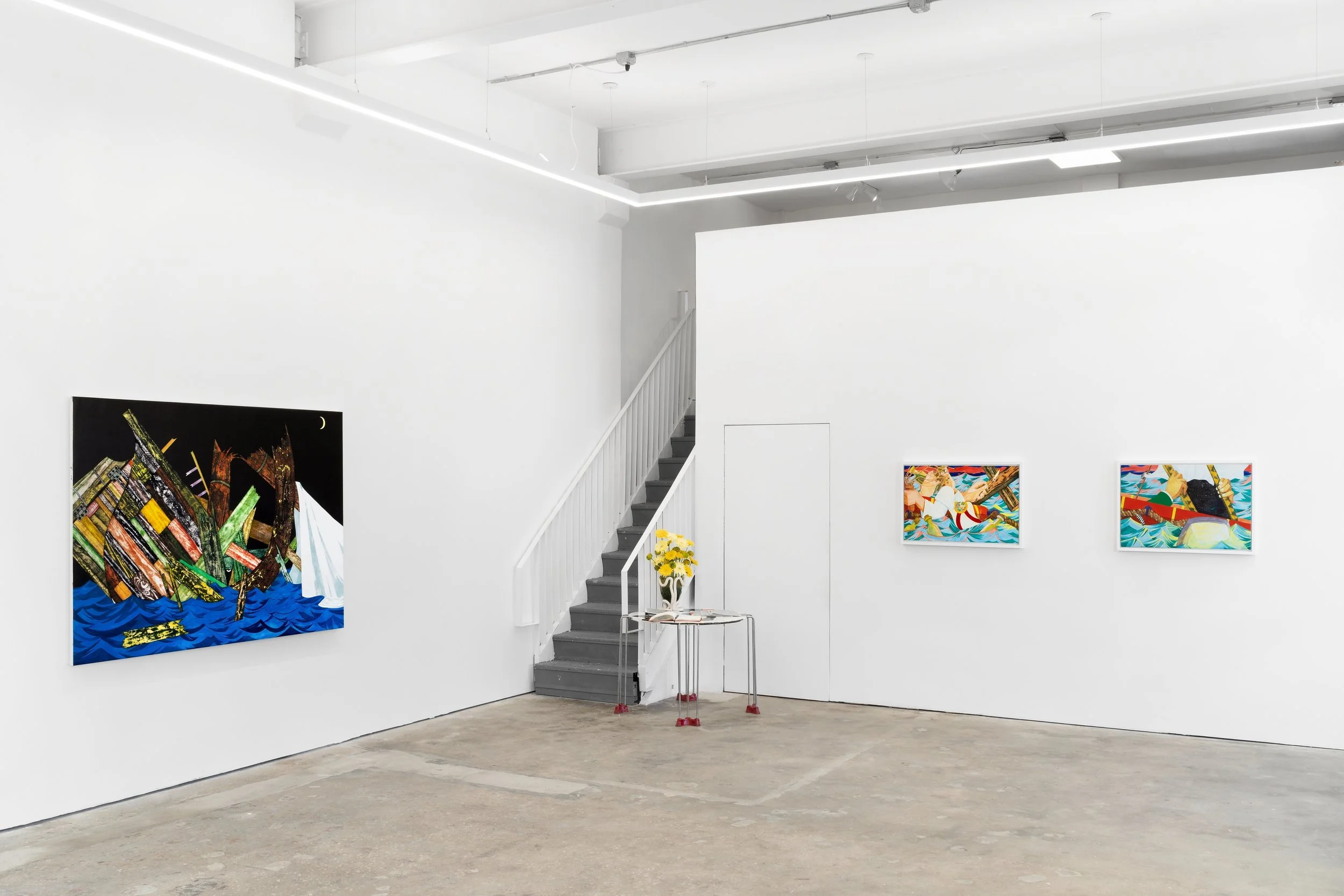
The Voyage is Miami-born artist Mark Thomas Gibson’s homecoming. The paintings in the exhibition depict the artist’s journey of return over perilous seas. The “voyage” of the title is both an allegorical self-portrait—the artist is the ship, with a little cartoon eye—and an oblique critique of American history and contemporary politics. Is a return “home” possible, Gibson seems to ask, after an extended period of time, when both journeyer and destination have changed? The question gathers urgency in our current political moment, as newscasters and analysts from both parties talk of pendulum swings: “the pendulum will swing back.” The physics of the pendulum, in which the little bob swings back and forth unaltered by its journey, governs the politics of nostalgia. But Gibson alerts us this nostalgic model has a fatal flaw. There is no “going back” unchanged. History is not a light traveler: it accumulates baggage, psychological and material, as it goes along. We travel with the memory of where we’ve been, the bounty and the horror. The buried pun in the title Returns on a Homeward Tide poses the question: what are the returns on return? What are the gains or losses accrued?
In building his narrative/vessel, Gibson has a vast sea of literary, art historical, and philosophical sources from which to cull ideas and images. The first case of nostalgia—originally, the disease of sailors—was Homer’s Odysseus, shipwrecked and pining for home. Gibson also rehabilitates Théodore Gericault’s magisterial Raft of the Medusa (1819), drawing inspiration from the carefully composed chaos of its forms and the political impulse of its representation. And he calls to Black Blackpainter Robert Colescott, in his antic and viciously satirical burlesque, Wreckage of the Medusa (1978). The raft has finally disintegrated. Studding a cerulean sea like plums in pudding are: babies in cradles, life vests, upside-down legs, and racist caricatures. Transgressive, raucous, this is a painting “gone overboard.” From Colescott, Gibson borrows the conceit of bobbing flotsam and jetsam from a wreck, as well as a palette of bright, bold colors (including the band of sky). In Gibson’s work, violence and grotesquery pop on the eye with bright irony.
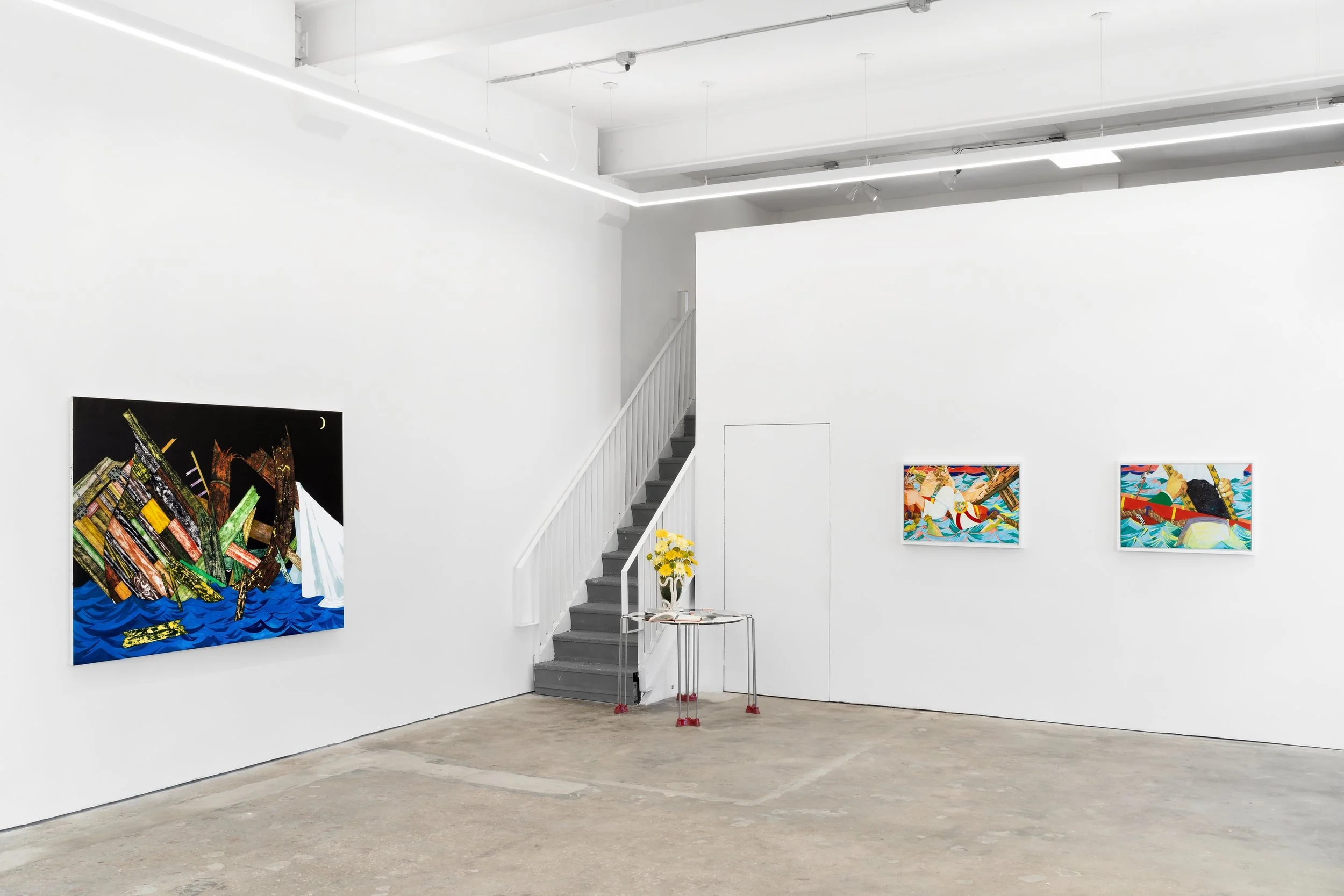
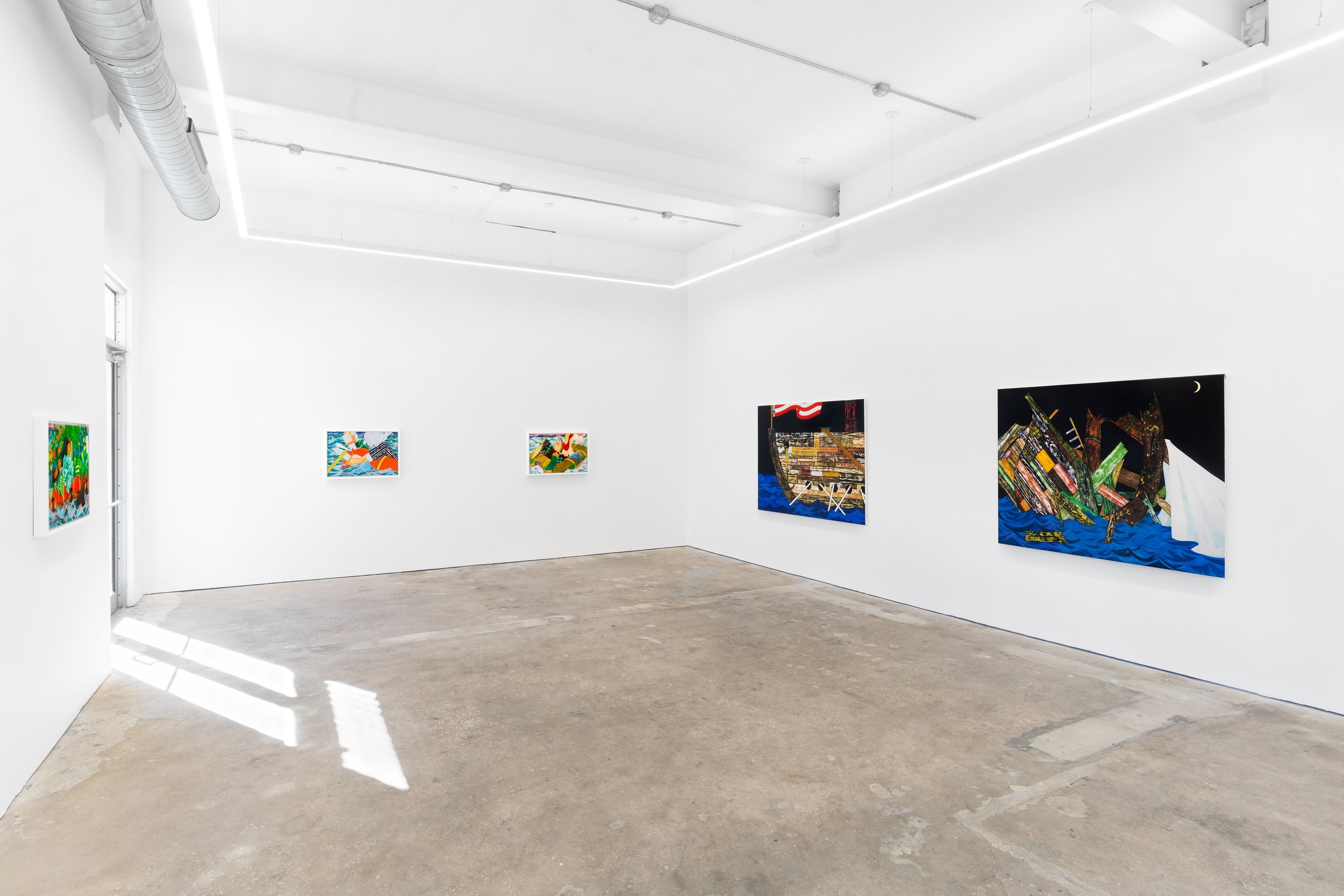
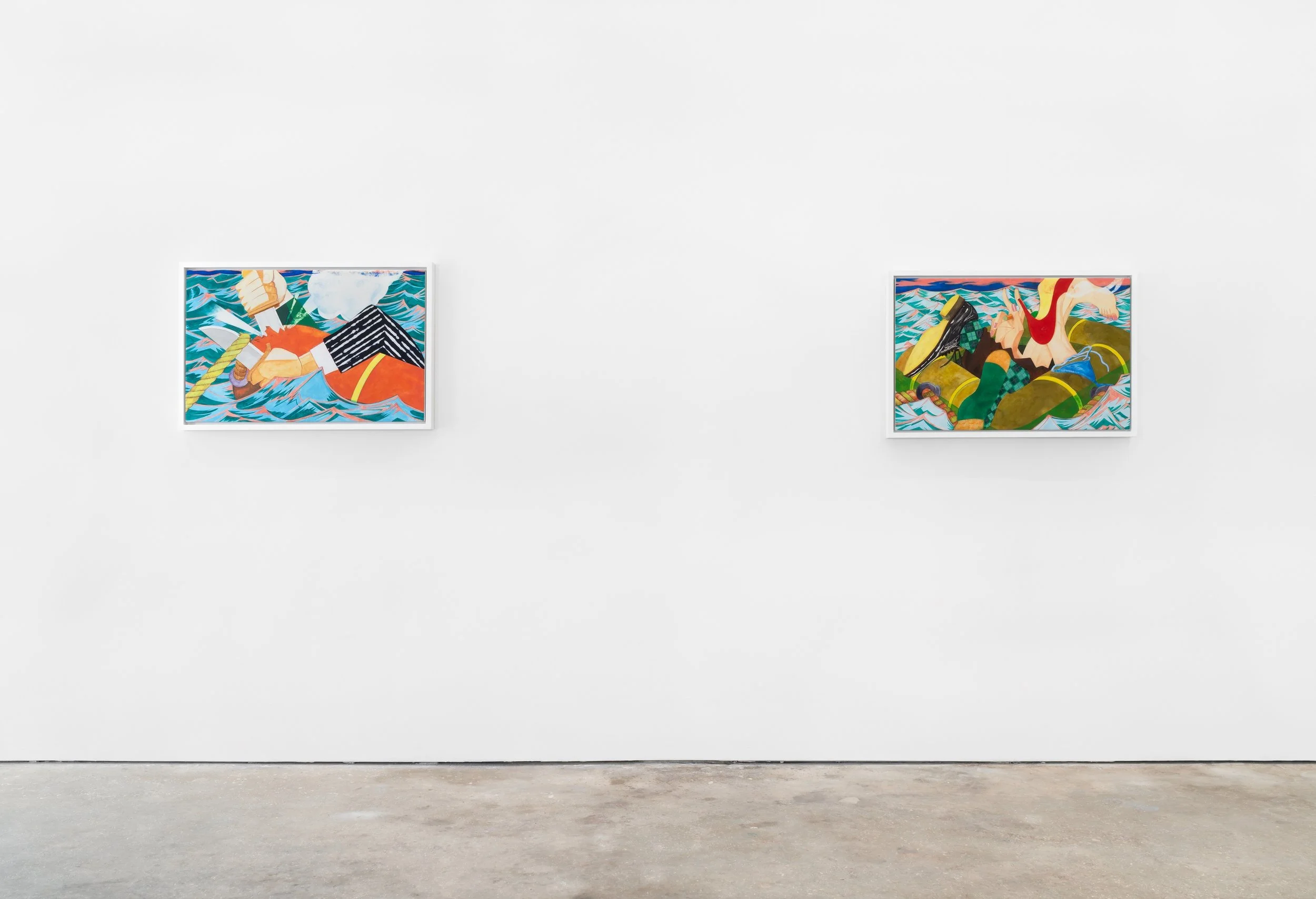
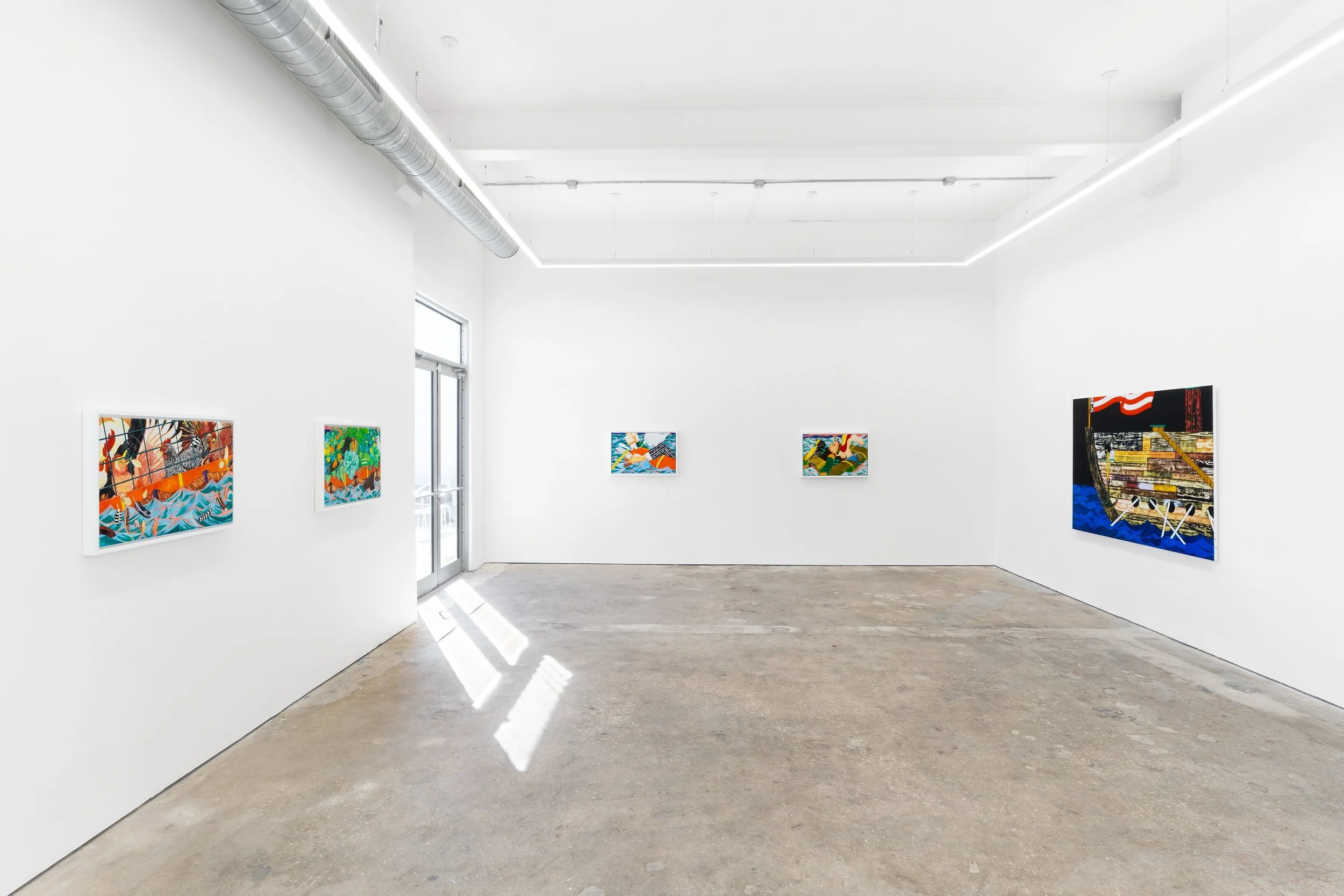
Still another line of influence comes from the visual grammar of comic-books. Gibson is a storyteller, and his narratives often take the form of sequential art. This exhibition’s eight ink-and-acrylic paintings evoke comic-book frames or panels that pace the measures of a continuous story. While each image floats in its own sea of white wall, a moment-to-moment relationship between images ties them loosely together. Perceptual units coalesce across these spatial gutters, transforming the gallery into a three-dimensional comic book one reads in the round. This flickering evocation of sequence (as opposed to simple series) performs, on a subliminal level, the big questions the work is asking about continuity and rupture, identity and change. The reader of comics knows to “read” adjacent images—say, of a ship—as one ship at two successive moments in time. Yet, a reader unfamiliar with the grammar of this sequential form might insist on the indubitable visual fact: there are two ships, side-by-side. By a storytelling trick, we’ve been tricked into imagining them as one and the same.
Is it the same ship? This is, in fact, the essence of the philosophical thought experiment to which Gibson’s ship paintings further allude. The paradox known as the “ship of Theseus” pivots on the story of a great Athenian hero whose ship is “preserved” over many centuries. As the wooden planks decay, they are replaced by newer, sturdier ones. Eventually, not a splinter of wood from the original ship remains. The ancient philosophers stand divided, Plutarch reports: half claim the ship is the same, the other half say it’s not the same. As versions or descendants of Theseus’ ship, Gibson’s ship paintings ask: how can things—ships, people, democracies—change while also staying the same? With their unevenly caulked, mottled planks, Gibson’s self-portrait ships are Ships of Theseus, living embodiments of renewal made into (likeable, even cute) comic grotesques.
The narrative of The Voyage jerks into motion with a perceptual double-take. Two ships, as if a single beat apart, one wrecked, one whole. The first journey is over before it can begin; the second unfurls in an extended train of six smaller canvases, revealing between them a strange train of inflatable life rafts loaded up with the arcana of history and memory. Returns on a Homeward Tide shows the ship as a Frankenstein of asymmetrical, multi-sized and -colored boards. An eye cavity port hole sets the course, driven by its cycloptic view of the world. The grounding element of an anchor hangs from a gold chain—the artist’s father’s—tied to the eye-port. This ship is a self-portrait of the artist “returning on a homeward tide,” moving forward while staying grounded (the anchor-and-chain of generational memory and familial connection). Oars pulling and grabbing at the water from different directions propel the craft onward in a beetle-like scuttle. Above the foremast, an American flag ripples in a stylized wave, marking the artist’s place of origin and sneaking in an allusion to Gibson’s recent body of work based on the imagery of the flag.
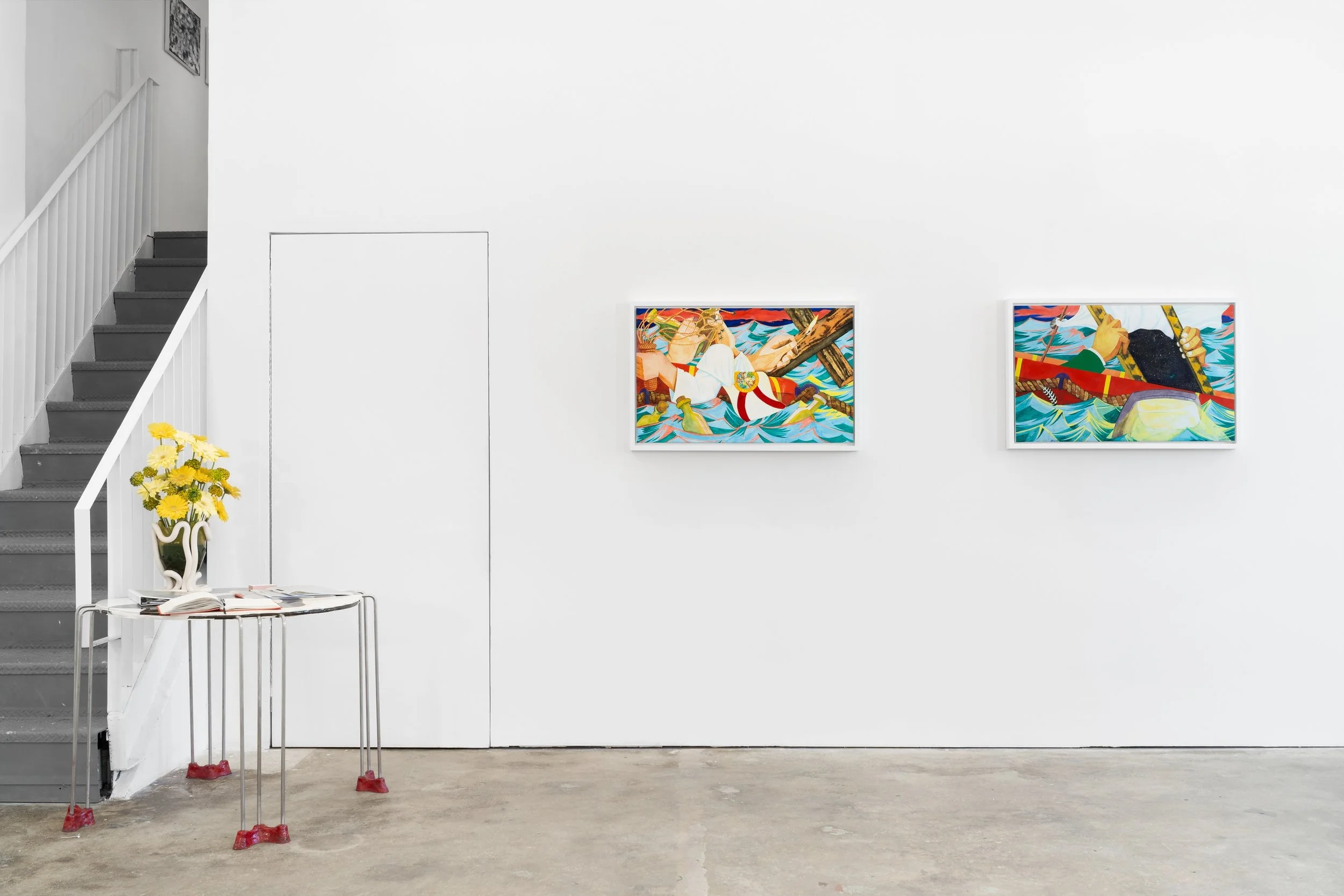
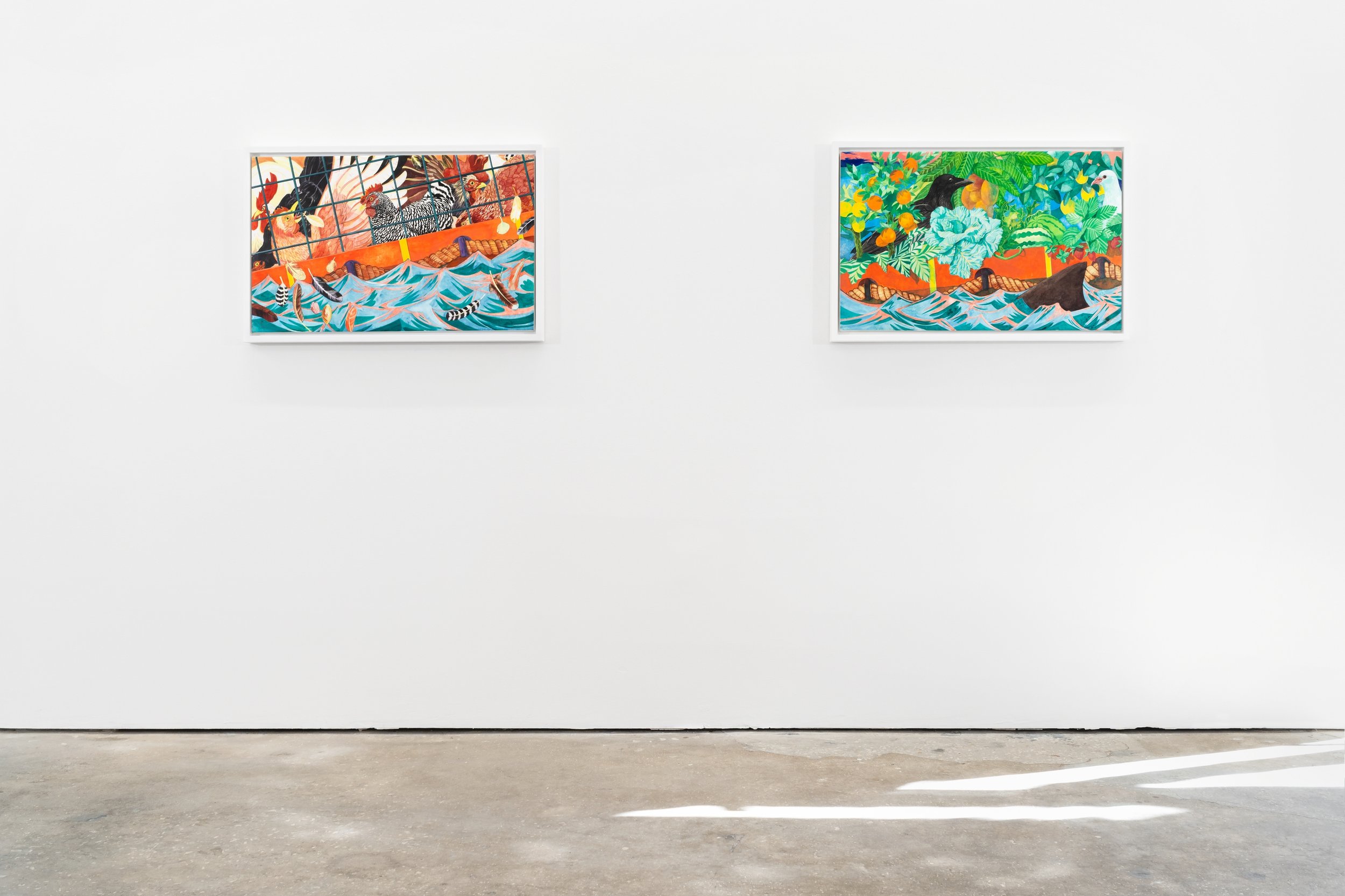
“The sea is history,” as St. Lucian poet Derek Walcott reminds us in his poem of that name. The movement of the ocean, with its back-and-forth and rise and fall, is nothing like the linear arrow with which history and time are often modeled. These tidal movements (and the way of thinking those movements imply) inform the Barbadian poet and theorist Kamau Brathwaite’s notion of “tidalectics,” a riffing on Hegel that replaces “the notion of one-two-three, Hegelian” with the cyclical, nonlinear movement of the water backwards and forwards. Gibson’s oceanic metaphor opens out into an entirely different theory of history and historical change, one that resists the linear progression of past-present-future and imagines instead a fluid continuum moving in a “tidalectic” manner. In Gibson’s imaginary, complex new entities—people, persuasions, ideas—coalesce on the surface of these waters, churned up by powerful currents operating in deep time. Collected in a string of inflatable life rafts, all tugged along by the ship in Returns, these resurfacing historical elements include: Saboteurs, Conspirators, Justice, Bounty, The Universe, and Lovers.
In Crew of Saboteurs, the corner of an inflatable raft can be seen bobbing in choppy waters. Waves lap at the sides, their sharp peaks glinting in the lurid light. The arms of two passengers clad in clashing business suits (stripes, solid color) hover above the raft’s tubing. Both are wielding knives; neither is up to any good. One punctures the corner of the raft, releasing a comic-book speech balloon full of hot air. The second arm saws through the safety rope with a knife, cutting the lead raft away from the others. This scene of sabotage on the high seas is a double-edged allusion: while satirizing the ineptitude and callous indifference of contemporary American politicians in our two-party system, it also alludes to the historical scenario depicted in Géricault’s Raft of the Medusa. When the French naval frigate Méduse ran aground, 150 people were forced onto a makeshift raft, which was cut loose and abandoned by the lifeboats bearing higher-status passengers.
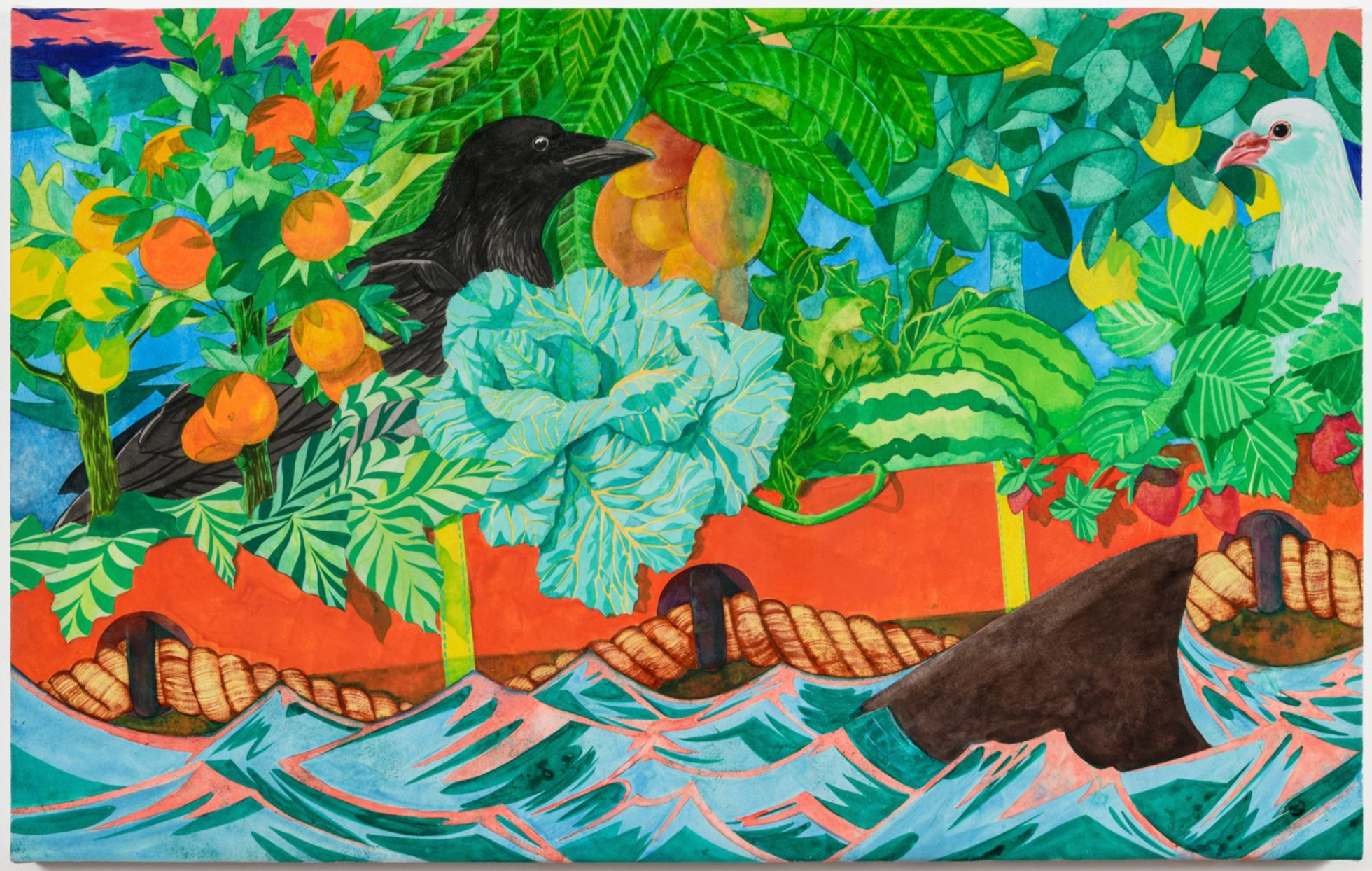
Bound to Roost floats by with a cage of captured (“bound”) roosters. Their crowing heralds the unfinished business of the longue durée of slavery and exploitation, announcing a day of reckoning. The phrase “bound to,” as in “bound to happen,” introduces an element of prophesy; it reminds us just what long injustice breeds. This raft brings the chickens home to roost, feathers flying.
In Conspirators at Sea, disembodied arms wearing Klan gear, looming huge in the foreground, appear alongside a life raft draped with the Florida State seal. One hand holds a lit match to a cross, while another one waves a barbed whip. Two others clutch bottles (to drink? To send a bottled message?). The title of the painting reveals the origin of these violent revelers/messengers from the past: they are the hooded Klansmen from Philip Guston’s no-longer-extant painting The Conspirators (c.1930), which was destroyed by LAPD “Red Squads” in cahoots with members of the KKK—an outburst of the very violence the paintings depict. The Klan would lie dormant in Guston’s work for years before resurfacing in the 1960s, albeit in changed form (now rendered cartoonish, ridiculous). In throwing a life raft to Guston’s lost painting, rehabilitating its figures and themes in the artist’s own idiom (and combined with elements of his own life, as in the Florida affiliation), Conspirators at Sea acknowledges an artistic debt while meditating on the longe durée of white supremacist violence, surfacing in waves throughout our history. After all, the polarized period in which Guston’s painting was vandalized eerily anticipated the right-wing backlash that led to the first Trump presidency.
Attached to this chaotic processional is a sprawl of two entangled lovers who have turned their raft into a pleasure cruise. Gibson seems to view their collective indifference with a mix of censure and permissiveness. This parade of rafts, filled with the materials of Gibson’s craft, has room for pleasure, too. As a flippant inversion at the very end, Gibson’s characters say: “Après moi, le deluge.”
-Exhibition Text written by Emmy Waldman
Emmy Waldman is an incoming Assistant Professor in the Department of English at the University of Miami in Coral Gables, Florida. She earned her PhD in English from Harvard University, specializing in contemporary literature and visual culture with a focus in comics.
MARK THOMAS GIBSON
(b. 1980, Miami, FL) received his BFA from The Cooper Union in 2002 and his MFA from Yale School of Art in 2013. Mark Thomas Gibson’s personal lens on American culture stems from his multipartite viewpoint as an artist, a professor, and an American history buff. These myriad and often colliding perspectives fuel his exploration of contemporary culture through the language of painting and drawing, revealing a vision of America where every viewer is implicated as a potential character within the story.
Gibson co-curated the traveling exhibition Black Pulp! with William Villalongo. The show examined evolving perspectives of Black identity in American culture and history from 1912 to 2016 through printed media and artworks. Gibson has published two books, Some Monsters Loom Large and Early Retirement. Gibson has been awarded the Pew Fellowship, the Hodder Fellowship, the Guggenheim Fellowship, The Louis Comfort Tiffany Foundation grant and the Chiaro Award. His most recent museum solo exhibition, Overture, premiered at the Berman Museum of Art in Collegeville, PA January 2025; Lineage (The Library Company of Philadelphia, Philadelphia, PA, 2024), Whirligig! (Sikkema Jenkins & Co., New York, NY, 2023), and A Retelling (MOCAD, Detroit, MI, 2023). Gibson's work is part of the permanent collections of the Beth Rudin Dewoody Collection, West Palm Beach, FL, Baltimore Museum of Art, Baltimore, MD, The West Collection at SEI, Oaks, PA, Peggy Cooper Cafritz Collection, Lumpkin-Boccuzzi Collection, Metropolitan Museum of Art, New York, NY, Beinecke Rare Books and Manuscripts Library, New Haven, CT, Library of Congress, Washington D.C., The University of Kansas, Lawrence, KS, Nelson-Atkins Museum of Art, Kansas City, MO and Hillsborough Community College, Tampa, FL He is represented by Loyal, (Stockholm, Sweden). He is currently an Assistant Professor of Painting at Rutgers Mason Gross School of the Arts New Brunswick, NJ.